Julieann Fernandez-Thomson: “Chemistry doesn’t tell you whether a whisky makes you want to take another sip”
One of the things that defines whisky making is, without a second thought, the strict discipline at every stage of the process, and of course the consistency of the end result. Producers don’t simply let things happen. There are no “natural” whiskies here, which is why randomness, in practice, does not exist. And the result doesn’t only affect the batch coming off the still: the whiskies that will be made in ten, twenty, thirty years depend on it too. Which is why there is a phrase you will hear at distillery after distillery when you ask about their processes — why they ferment for 55 hours and not 70, why this cask and not the one next to it, why we wait 12 years and not 13. The phrase is “because that’s how we’ve always done it”, and to the uninitiated it explains very little, although it may well explain everything.
Julieann Fernandez-Thomson walked into whisky having been trained, in a way, not to accept phrases like that. She studied forensic science, expected to end up in scene-of-crime work or in a police laboratory, and then, almost by magic, ended up overseeing and signing off the whiskies of three major Scottish distilleries — before she turned thirty. “Okay, but what happens if we don’t?”, I imagine her saying in her first days, standing over the still.
It is not yet two years since my last trip to Scotland, where on Islay I had the chance to visit, among others, the Bunnahabhain distillery. You will find a detailed piece on that here. I didn’t manage to meet her in person then, as she is based in Glasgow, at the bottling facility of the three distilleries. But I wanted to make contact, and above all to hear her own approach as the person responsible for the final whisky of three great brands, so we spoke online — and after our conversation, I decided to write this.
For those who don’t know her, Julieann Fernandez-Thomson is the Master Blender of CVH Spirits. In her hands are three distilleries — Bunnahabhain on Islay, Deanston in the Highlands and Tobermory on the Isle of Mull, which also produces the peated Ledaig — as well as the blends Black Bottle and Scottish Leader, neither of which is imported into Greece.
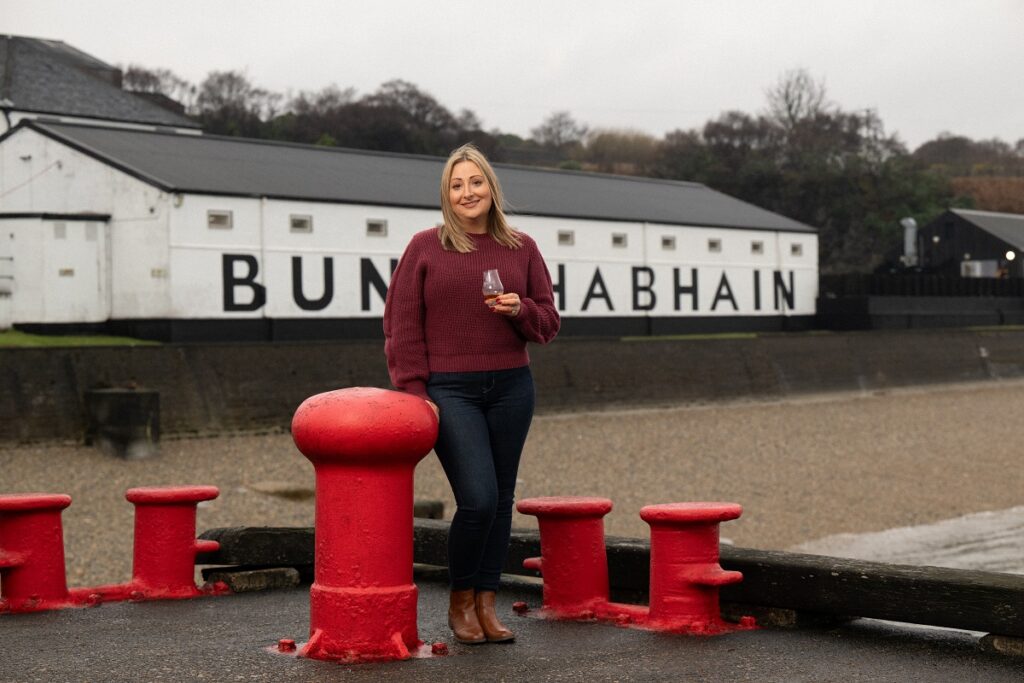
Her first contact with whisky came through her work placement, while she was still a forensic science student. Forensic science is, in practice, analytical chemistry, and the instrument that hunts for traces in a sample or an object from a crime scene is the same one, or close to it, that measures congeners in a whisky. So Julieann Fernandez did her placement in a laboratory that analysed whisky — at Kilmalid, to be precise, which operates in Dumbarton for Chivas Brothers.
Next came the Scotch Whisky Research Institute, before she joined what was then Distell as a young blender. Up to that point she didn’t even drink whisky; she had a thoroughly Scottish office-and-laboratory job. And then everything changed.
In 2019 she was promoted to Master Blender, the same year she was expecting her first child. In 2022 she won Master Blender of the Year at the Icons of Whisky, and was later made a Keeper of the Quaich.
Two more details. Her father is Spanish, from Andalucía — hence the surname — and she spent part of her childhood there; hold on to that for later. And when Heineken bought Distell in 2023, the Scottish arm was spun off and became the independent CVH Spirits, under whose umbrella the three distilleries in this piece now sit. So in this case there is no safety net, and none of the constraints a multinational usually imposes. Whether there are directives, I don’t know. Perhaps we’ll find out together.
Our conversation started from exactly what I mentioned at the top: you are young, restless, you walk into a world with centuries of habits, and you insist on asking why. What holds up when you test it, and what turns out to be a plain habit nobody can account for?
“If somebody tells me, ‘We always do it this way,’ my next question is usually, ‘Okay, but what happens if we don’t?’”
And very often, she explains, tradition turns out to be entirely justified. Fermentation times are the example she gives: change the length and the character of the spirit changes with it. The same goes for yeast choice, distillation parameters, cask management. “These things have genuine consequences, and generations of whisky makers have learned that through experience.”
But there are the others too, the ones where the answer is essentially “Well, that’s how we’ve always done it.” She doesn’t consider that a bad thing, on one condition: that we are willing to test it.
The formulation I liked best is her refusal to set science against tradition: “I never want science to come in and say, ‘Tradition is wrong.’ It’s more interesting to say, ‘Let’s understand why tradition works, and then see whether there’s another way of achieving the same thing — or perhaps something even better.’”
If you think about it, that is a sentence that stands up in a great many fields, not only in whisky.
Three distilleries, three different people
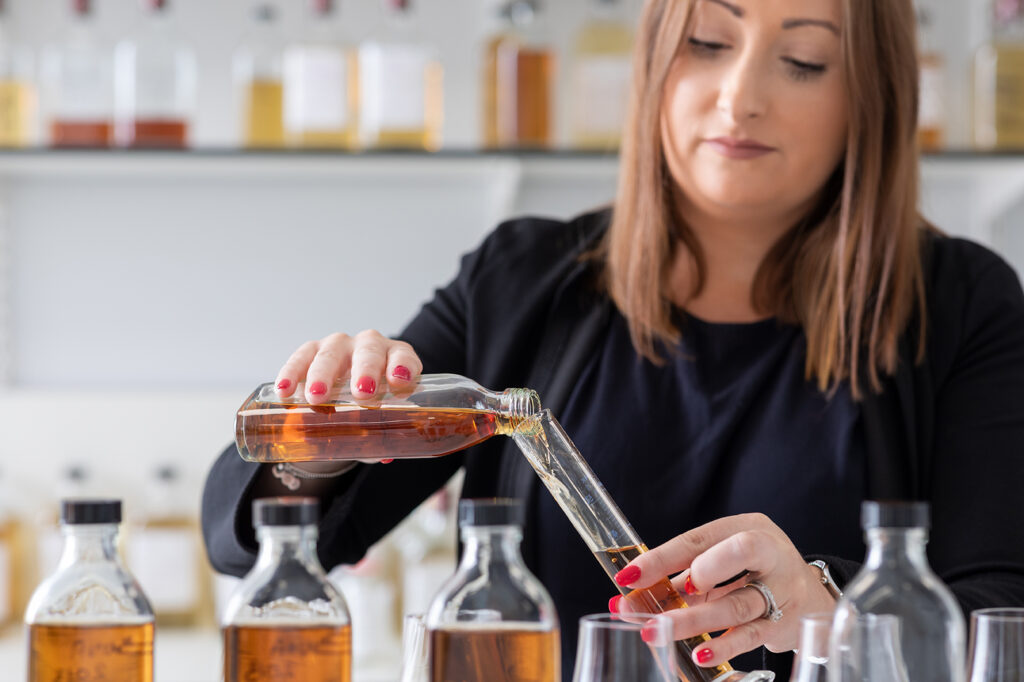
I asked her how she manages to work inside three fairly different worlds, serving three dissimilar distilleries with three different styles and characters. Her answer turns the question around: she doesn’t start, she explains, by thinking about what whisky she wants to make, but about the character the distillery already has. “I don’t approach them thinking about what I want the whisky to be. I approach them thinking about what that distillery already is.”
Bunnahabhain, she explains, “has that beautiful coastal character. Unpeated, but not necessarily delicate. There’s salinity, fruit, a lovely richness, and then you have the sherry influence that can bring dried fruit, spice and depth.” Deanston is something else: “There’s a lovely honeyed, waxy, creamy quality to the spirit” — that waxiness that settles on the palate like beeswax — “It’s quite bright and approachable, and that gives you a different canvas to work with.” And then we arrive at Mull, where Tobermory and Ledaig are “almost like two personalities living on the same island”: “Tobermory has that freshness and fruit and coastal character, whereas Ledaig gives you smoke, earth, maritime notes and overall is something much more muscular.”
“So I don’t really switch personalities; I switch ears. I’m listening for what each whisky is trying to tell me.” That line of hers stayed with me.
And she adds something few people in her position would say out loud: she would have no problem spending a whole career with a single distillery style, and would probably become very good at it. “If I spent my whole career working on one style of whisky, I’d probably become very good at it, but working across these different distilleries keeps you curious.”
Balance (of flavour)
Having talked with dozens of producers, brand managers and representatives of large and smaller brands alike, one of the stock lines I hear constantly is the one about balance in flavour. Every blender will tell you that is the aim. Fernandez-Thomson had something more interesting and less clichéd to tell me: that she chases it “but not at the cost of personality”. We have all tasted whiskies, and spirits in general, so round, so balanced and so well-made that they become uninteresting. Still, I asked her to show me exactly where she draws that line.
“For me, balance doesn’t mean making everything softer,” she answers. Sometimes a whisky needs an edge. “Sometimes it’s supposed to be smoky, salty, spicy or really rich. If I smooth all of those things out in the name of balance, I’ve actually taken away the reason you wanted to drink it in the first place.”
She gives me the example of the Deanston Orange Wine, a 17-year-old that spent its last two years in vino de naranja casks from Andalucía. Seven thousand bottles at 53.6%, sold out. “There was a point where we could have kept pushing the maturation until everything became very polished and obviously ‘finished’. But I didn’t want the cask to completely take over the spirit. The point was to let the wine influence add another layer while still allowing you to recognise Deanston underneath it.”
Her background is not unrelated to that choice — her parents met in Andalucía, and she has spoken elsewhere about the smell of the oranges as they ripen. And her line runs exactly there, between a personal story that very easily turns into marketing and a finish that smothers the spirit: she wants the character of each distillery to stay legible. “If you take away the things that make a whisky distinctive, you’ve achieved balance, but you’ve lost personality.”
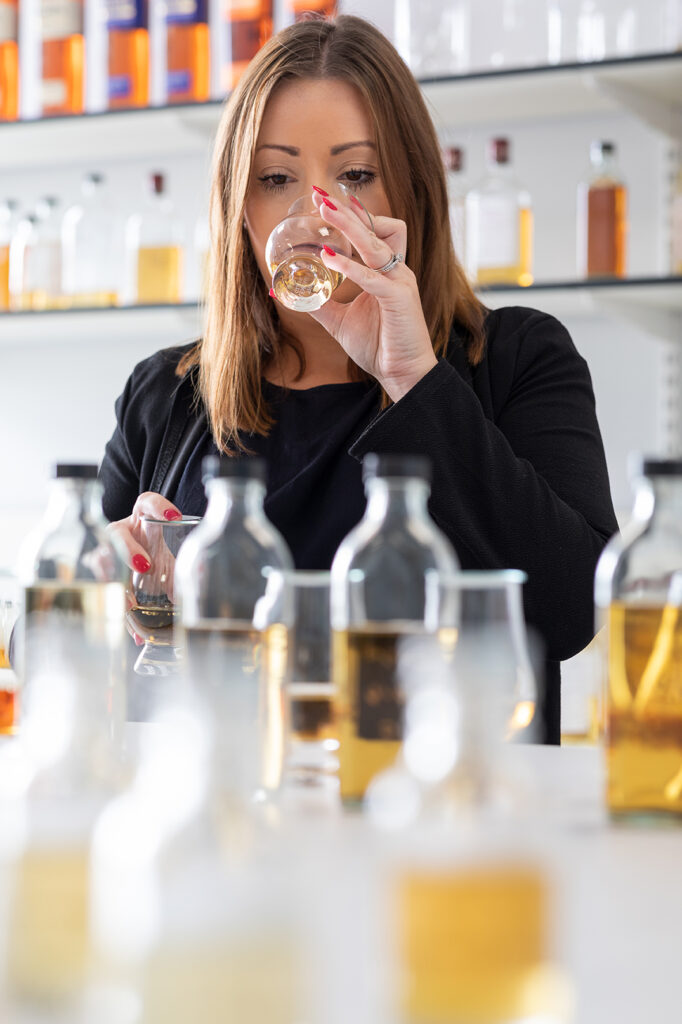
Julieann Fernandez has said in the past that whisky is “mainly art”. Coming from someone whose job was the chemical analysis of samples, that is paradoxical to say the least, so I ask her straight out: is there anything in the glass that her analyses do not explain?
“Absolutely.”
They measure an enormous amount now: “alcohol strength, congeners, compounds, maturation characteristics, colour, all sorts of things.” She loves that, she says, because “it gives us another language for understanding whisky.” Then she sets the limit:
“But chemistry doesn’t tell you whether a whisky makes you want to take another sip.”
She talks about whiskies where you can name every aroma separately and yet “somehow the whole thing becomes more than the sum of its parts.” About texture, about “the way flavours arrive and disappear.” And about something those of us who write about whisky skip over far too easily: context. “I’ve had whisky taste completely different to me depending on whether I’m tasting it in a warehouse, in the lab, at home, or with a group of people.”
And then a line I did not expect from a scientist: “So yes, I can analyse what’s in the glass. But I can’t put a number on why something gives you that little moment where you think, that’s really special. And honestly, I hope we never completely can.”
On blended Scotch whisky
Black Bottle can have fifteen components or more. I asked her whether making a blend is harder than making a single malt, and why, in spite of everything, blends still don’t get the respect they deserve from whisky lovers.
They are difficult in different ways, she says. With a single malt you are trying to understand one distillery’s character and build around it. With a blend, “you’re effectively conducting an orchestra. Every component has a role. Some are there for structure, some for fruit, some for sweetness, some for smoke, some might be almost invisible individually but absolutely essential to the final balance.” And the hard part is that “the components don’t just add together. They interact.”
For the disdain towards blends she has an explanation that has nothing to do with flavour: we see them as less romantic. “There’s a perception that single malt is the ‘serious’ whisky and blend is somehow simpler.” Single malts have a place, a history, a face. Blends appear to be the simpler thing.
She doesn’t accept that at all: “One of the things I love about Black Bottle is that you can make something incredibly complex while still making it incredibly drinkable. That’s a very difficult thing to achieve.” And she closes with a sentence that deserves to be printed and hung in a few bars, the way Ted Lasso hung up BELIEVE: “Whisky doesn’t have to be difficult to be good.”
Tequila, Tokaji, orange wine, Rioja. Deanston has become her laboratory and her island. I asked her how she decides that a cask is worth the risk, and to tell me about an experiment that didn’t work.
The first thing she explains is that she doesn’t put a cask into the process because it is unusual. “’It’s a tequila cask’ isn’t a flavour profile. That’s the starting point for a question.” What the previous liquid did to the wood, what the wood can contribute, what the spirit underneath will do with all of it — “and, probably most importantly, whether the combination makes sense.”
On the failures, the wording is restrained but clear: there were experiments where the cask influence was simply too dominant. “The wood was shouting louder than the spirit. And that’s useful information too.” Then she turns it around: “The best experiments aren’t necessarily the ones where everything works. Sometimes the failures tell you exactly where the boundary is.”
I ask whether she has ever thought about Greek casks —Mavrodaphne, Samos Muscat, Santorini Vinsanto. The answer was yes, and with a precision I didn’t expect: “With something like Vinsanto, for example, you’ve got the potential for dried fruit, sweetness, oxidative character and those darker, richer notes.”
Then she sets the condition, and it is the right one: “But I wouldn’t do it simply because it sounds exotic. If we ever put a Greek wine cask into one of our whiskies, I would want it to feel inevitable in hindsight, rather than gimmicky. That’s the test.” And the criterion: “Something where you taste it and think, ‘I couldn’t have got that character any other way.’”
Thinking like a historian
You cannot talk to anyone in Scotch whisky today without touching on the crisis it is going through. Falling consumption, stock surpluses, trade tensions. I asked her how a blender plans today for a whisky that will be released in ten, eighteen or twenty-five years.
She says it plainly: it is one of the hardest parts of the job, “because you are making decisions today for a consumer you can’t predict.” You can’t say “’This is what people want now, so let’s make more of it.’” By the time it comes out of the cask, tastes, markets, regulations “and even the way people drink whisky” will have changed.
Her strategy is not prediction but flexibility: enough diversity in the stock to leave you with options. “You can’t predict the future perfectly, but you can avoid locking yourself into one future.” And then the line that sums up the whole profession: “We’re custodians of something that is going to outlive us. You have to think commercially, but you also have to think like a historian.”
I put the counter-argument elsewhere: what happens when the commercial plan points to now as the moment to bottle, and the whisky says not yet? “There have definitely been moments where I’ve had to say, ‘I understand the commercial opportunity, but I’m not convinced the liquid is ready.’” If something goes out with her name on it, she says, “I have to be able to stand behind what’s in the bottle.”
She doesn’t see herself as the person who says no to the commercial side, but as the one who makes sure the liquid gets heard: “I don’t see my role as being the person who says no to commercial thinking. I see it as making sure the liquid has a voice in that conversation.” “And sometimes the answer is compromise. Sometimes it’s patience. And occasionally it’s simply saying, ‘Let’s not release this one.’”
On younger drinkers, her answer carries no trace of grumbling. “They’re much less interested in being told how they’re supposed to drink whisky. That, to me, is brilliant.” They ask about cocktails, highballs, different serves, lower-strength expressions, experimental releases. They drink whisky alongside tequila and wine without asking anyone’s permission.
“When I started, there was sometimes this feeling that you needed to know everything before you were allowed to have an opinion. I really don’t believe that. You can be drinking whisky for five minutes and still know what you like.”
From there we moved to her own corner of the industry. She sees more women across distilling, blending, production, engineering and leadership. Then she says the most interesting thing of all: she doesn’t want that to be remarkable. “I’d love to get to a point where nobody says ‘female master blender’ because the word female isn’t interesting anymore. It’s just ‘master blender’.”
I reminded her of something she had said in an earlier interview, that she was fortunate never to have experienced discrimination — and that other women would call that a generational gift, paid for by those who came before her. She didn’t dodge it.
“Yes, I think there’s a lot of truth in that.” She has not personally lived the discrimination others describe, “But I don’t think that means it didn’t exist.” And further on: “There were women before me who absolutely had to push those doors open. They had to prove themselves in environments where they weren’t necessarily expected to be there. I get to walk through doors that are already open because of that.”
She defines the obligation in practical terms, not political ones: “If a young woman comes into whisky and I can make her think, ‘I belong here,’ then that’s important to me.”
To close, I asked her where she would like to be in twenty years, and which whisky she would want to be remembered for. The first word of her answer was neither a brand nor a job title: “Hopefully still curious.” She doesn’t want, she says, “to reach a point where I’ve decided I know everything about whisky, because I don’t think that’s possible.”
As for the bottle she would like to leave behind: “technically precise, but with personality. Something where you can taste the quality of the liquid, but also the curiosity behind it.” And if someone tastes it and says “You can tell Julieann made that,” she will be very happy — “Not because it tastes like everything else I’ve made but because it has its own character.”